
Home Blog

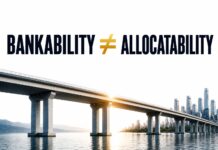
Allocatability, not Bankability, may be the Primary Constraint on Infrastructure Capital at Scale

0

Analysis released ahead of the G7 Summit and London Climate Action Week argues that infrastructure capital formation is increasingly constrained by allocatability rather than capital availability.

LONDON — Despite three decades of guarantees, blended finance structures, political risk insurance and first-loss capital mechanisms, the global infrastructure financing gap remains substantial.

This persists even as more than US$300 trillion is already allocated across institutional portfolios worldwide.

A new analysis released today by the Sustainable Markets Initiative (SMI), Africa investor (Ai), the Institute of Sovereign Investors (ISI) and partners suggests that the principal constraint on infrastructure capital formation may no longer be capital availability.

It may be allocatability.

Infrastructure may be bankable without being allocatable.

The infrastructure challenge is no longer simply how to finance infrastructure.

It is how to create allocatable exposure.

The infrastructure constraint is increasingly fiscal rather than financial.

Governments face infrastructure requirements that exceed what public balance sheets can fund and what MDB-led de-risking mechanisms can mobilise at scale.

Governments scale infrastructure through balance sheets.

Institutional investors scale infrastructure through allocations.

As fiscal capacity becomes increasingly constrained, infrastructure capital formation may depend less on additional risk-transfer mechanisms and more on whether infrastructure exposure can satisfy institutional allocation requirements at scale.

Bankability determines whether projects obtain financing.

Allocatability determines whether exposure can enter the portfolio, benchmark and governance systems through which institutional capital is allocated.

These conditions are not equivalent.

Projects may satisfy lender requirements, attract financing and achieve commercial viability while remaining absent from institutional portfolios.

Institutional capital does not allocate to projects.

It allocates to admissible exposure.

Allocatability Risk-Bounding (ARB) addresses the conditions through which infrastructure exposure becomes institutionally allocatable.

The analysis is being released as leaders, sovereigns, investors and policymakers gather for the G7 Summit and London Climate Action Week to identify practical mechanisms capable of accelerating private capital mobilisation for resilient infrastructure systems.

Its central proposition is straightforward:

  • Bankability determines participation.
  • Allocatability determines scale.
  • Scale determines the cost of capital.
“For decades, infrastructure finance has focused on reducing risk in order to attract capital. Yet the financing gap persists despite significant innovation in guarantees, blended finance and risk-transfer mechanisms.The challenge is not capital availability. The constraint is institutional allocatability. Governments scale infrastructure through balance sheets. Institutional investors scale infrastructure through allocations. As fiscal capacity becomes increasingly constrained, the question is no longer simply how to finance infrastructure. The question is whether infrastructure exposure can become allocatable. Institutional portfolios do not primarily allocate to projects. They allocate to admissible exposure. The challenge is no longer how to remove more risk. It is how to create allocatable exposure.” Dr Hubert Danso, Chairman and Chief Executive Officer of Africa investor Group.
“The world’s largest pools of capital allocate through mandates, benchmarks, governance frameworks and portfolio construction disciplines. A project may satisfy lender requirements and still remain absent from institutional portfolios. Infrastructure may be bankable without being allocatable. Allocatability provides a useful lens through which sovereigns, investors and policymakers can better understand the relationship between infrastructure development, institutional participation and long-term capital formation.” Kristian Flyvholm, Chief Executive Officer of the Institute of Sovereign Investors (ISI)

Infrastructure capital may increasingly scale not because risk disappears, but because exposure becomes institutionally allocatable.

As fiscal capacity becomes increasingly constrained, understanding the distinction between bankability and allocatability may become increasingly important for sovereigns, investors and policymakers seeking to mobilise capital at institutional scale.

Read the ARB analysis here: Allocatability-Risk-Bounding-ARB-Report-2026-.pdf

G7 Africa Heads of State Summit Advances Sovereign Infrastructure as Global Asset Class for the AI-Industrial Era

Sovereign Infrastructure establishes mandate-eligible institutional exposure across energy, critical minerals, logistics, compute, and corridor systems.

NAIROBI, Kenya 12 May 2026 — Leaders at the G7 Africa Forward Heads of State Summit advanced Sovereign Infrastructure (SI) as the benchmark-compatible asset class through which sovereign systems enter global institutional portfolios in the AI-Industrial Era.

The Summit was convened under the leadership of Presidents William Ruto and Emmanuel Macron, bringing together more than 30 African Heads of State alongside institutional investors, sovereign wealth funds, multilateral institutions and global financial leaders.

Discussions focused on green industrialisation, AI and compute infrastructure, sovereign energy systems, critical minerals, strategic corridors, investment competitiveness, sovereign risk perception and lowering structural costs of capital.

In response to growing sovereign calls to align development with institutional capital allocation requirements in the AI-Industrial Era, the Sustainable Markets Initiative (SMI), Africa investor (Ai), and the Institute of Sovereign Investors (ISI) released the Sovereign Infrastructure Asset Class architecture developed with institutional investors, sovereigns and global asset owners.

More than $300 trillion is already allocated across global institutional portfolios, yet sovereign infrastructure remains underrepresented because it has historically been organised as fragmented development projects rather than standardised institutional exposure.

Investment leaders stated that the principal constraint was not capital scarcity, but the absence of benchmark-compatible structures capable of meeting institutional allocation, governance and execution velocity at scale.

“The Institute of Sovereign Investors was pleased to contribute to the advancement of benchmark frameworks for sovereign infrastructure allocation.” said Kristian Flyvholm, Chief Executive Officer, Institute of Sovereign Investors.

Institutional capital allocates primarily through benchmarks, portfolio construction, ratings visibility and execution certainty rather than project-by-project mobilisation.

Sovereign Infrastructure establishes institutional-scale exposure through:

  • contracted long-duration cashflows,
  • ratings visibility, and benchmark compatibility,
  • execution and bankable offtake certainty,
  • programme-scale standardisation and replication.

The Institutional Investor–Public Partnership (IIPP) framework was introduced as the execution architecture supporting contractual standardisation, scalable deployment, bankable offtake structures and defined risk boundaries.

“For decades, development was structured as episodic projects while institutional portfolios allocated to asset classes. The defining transition is from making investment developmental to making development investable.” said Dr Hubert Danso, Chairman and CEO of Africa investor Group, speaking from the Summit. 

Africa’s estimated $3–7 trillion NDC and industrial transition infrastructure universe was highlighted as one of the world’s largest emerging sovereign infrastructure allocation universes spanning energy, critical minerals, logistics, compute and sovereign industrial platforms.

As artificial intelligence, energy systems, logistics, compute infrastructure and industrial supply chains converge, sovereign infrastructure platforms are becoming strategic allocation assets within global portfolios.

Sovereign Infrastructure provides sovereign governments with a pathway to align national infrastructure systems with institutional allocation requirements, green industrial competitiveness and lower structural costs of capital.

At the same time, it enables institutional investors to access benchmark-compatible long-duration real asset exposure at industrial scale.

“Capital does not scale through importance alone. Allocation scales where admissibility, benchmark integration and execution certainty converge.” Dr. Danso added

Read on Sovereign Infrastructure Asset Class Report

Pope Leo XIV’s Africa Visit Signals IIPPs as Pillar of Global Financial Architecture

0

Washington DC / Vatican City / Rome / Addis Ababa / London / Johannesburg — 24 April 2026

Institutional Investor-Public Partnerships scale private capital mobilisation by aligning sovereign priorities with $300 trillion institutional allocation systems

Africa investor today welcomed the historic visit of Pope Leo XIV to Africa, saying it signals the continent’s rising role in the global economy and in the systems through which capital is allocated at scale.

Global shocks continue to reinforce Africa’s centrality to the systems underpinning the $10 trillion global green industrial transition. The continent is increasingly integral to the energy, critical minerals, food, and digital systems shaping that transition.

This shift reinforces the role of Institutional Investor–Public Partnerships (IIPPs) as the execution architecture through which development becomes investable and compatible with the $300 trillion global institutional market. IIPPs are establishing themselves as a foundational pillar of the global financial architecture, central to advancing the private capital mobilisation reform agenda at scale.

With standardisation, pricing visibility and benchmark eligibility established, sovereign infrastructure assets enter institutional allocation systems as a distinct asset class.

“This visit recognises something structural. Africa is no longer peripheral to global growth. It is becoming integral to how the global economy functions. Capital does not need to be mobilised. It needs to be enabled as allocatable institutional exposure.” said Dr. Hubert Danso, Chairman and CEO of Africa investor.

The IIPP Architecture — launched for the World Bank Spring Meetings by Africa investor, the Sustainable Markets Initiative and the Institute of Sovereign Investors — aligns sovereign priorities with institutional mandates, enabling capital to allocate through rule-based platforms.

Industrial-scale investment in Africa is increasingly a global systems requirement, not a regional proposition.

“Faith can affirm dignity. Markets can scale dignity. This moment coincides with a structural shift — from development as narrative to development as investable institutional exposure.” Dr. Danso added.

Capital is not scarce.
Investability is.
IIPPs convert development into allocatable institutional exposure — and scale dignity through markets.

For the IIPP Architecture, visit: Institutional Investor-Public Partnerships - IIPP Architecture

Making Development Investable: IIPP Architecture Launched for the World Bank Spring Meetings

0

WASHINGTON, D.C. — April 2026

Global institutionally managed portfolios now exceed $300 trillion globally, yet private capital mobilisation into infrastructure, industrial systems, and transition assets remains structurally limited.

The constraint is not capital availability.

It is the absence of systems that translate development priorities into allocatable institutional exposure.

The implication is structural:
Not making investment developmental, but making development investable.
Institutional investors allocate through mandates, benchmarks, and governance rules.

Assets that meet these requirements enter portfolios through standard processes.
Those that do not remain outside allocation, irrespective of economic value or development need.

Capital allocates through eligibility.

Development becomes investable when it becomes eligible.

Structural Context
Development finance has historically expanded investment through project-level approaches.

These delivered important outcomes.
They established a foundation for what follows.

They did not scale within institutional allocation systems, which are now rule-based and increasingly automated.

Capital flows to system-compatible exposure — not to need alone.

The IIPP Architecture
The Sustainable Markets Initiative (SMI) and Africa investor (Ai), in partnership with the Institute of Sovereign Investors, has launched the Institutional Investor–Public Partnerships (IIPP) Architecture, developed with sovereigns and asset owners.

IIPP establishes the execution layer through which development is structured to meet institutional allocation requirements from inception.

It does not introduce new capital.
It redesigns how assets are formed, governed, and aggregated so they qualify for institutional portfolios at scale.

What Changes Under IIPP
– Eligibility is structured ex ante, not retrofitted.
– Governance and contracts are standardised prior to capital engagement.
– Assets are aggregated at platform scale, replacing fragmented project origination.

Development is no longer originated as discrete projects.

It is structured as allocatable exposure.

From Discretion to System
The allocation pathway shifts:

From:
Opportunity → Evaluation → Decision

To:
Eligibility → Approval → Allocation

This is not a change in financing instruments.

It reflects a change in how development is structured to meet allocation systems.

Implications for Sovereigns and Investors
IIPP replaces episodic deal-making with institutionalised execution platforms that reduce transaction friction, accelerate financial close, and lower the cost of capital over time.

Domestic pension funds, insurers, and sovereign wealth funds gain mandate-safe pathways to invest in national development priorities.

Global institutional investors gain benchmark-compatible exposure without bespoke exceptions.

Institutional Investor-Public Partnerships - IIPP Architecture is the execution layer through which Consequential Africa becomes allocatable at The Allocation Moment .

Where eligibility is achieved:

Investment Committees approve
Consultants validate
Benchmarks incorporate
Capital reallocates

Where eligibility is absent, allocation does not occur.

Alignment with the Global Transition
The global green industrial transition is estimated to exceed $10 trillion annually across energy, infrastructure, industrial systems, and supply chains.

The transition is global.
The opportunity is structural.

Africa’s ~$3 trillion NDC pipeline is a structural component of this transition.
IIPP aligns this opportunity with the scale and rules of global institutional capital.

Leadership Commentary

“The constraint has never been capital. It has been the absence of systems that convert development into allocatable exposure. The transition now underway is structural. Make development investable — by aligning sovereign execution with the rules of institutional capital from inception.” – Dr Hubert Danso, Chairman & CEO, Africa investor (Ai) Group
“Private capital mobilisation is a systems constraint. IIPP provides the foundational architecture through which development becomes compatible with institutional allocation systems at scale.” – Kristian Flyvholm, Chief Executive Officer, Institute of Sovereign Investors

The Structural Shift
As global portfolios seek duration, diversification, and real-economy exposure, the ability to structure development as allocatable assets becomes a defining condition of capital flows.

This marks a transition:

From: Persuasion-led development finance
To: System-based capital allocation

Conclusion
Capital does not require persuasion.

It requires eligibility.

Make development investable.

Where eligibility is achieved, capital follows.

Read: Institutional Investor-Public Partnerships - IIPP Architecture

Africa Faces Investability Gap Despite Trillions in Global Capital, Says Dr. Hubert Danso at EIB Forum

0

At the recent European Investment Bank (EIB) Global Forum, Dr. Hubert Danso, CEO and Chairman of Africa Investor (Ai) Group, highlighted a critical challenge facing Africa’s industrial development: the continent suffers not from a lack of capital, but from a shortage of investable development projects. Speaking at the €300 billion Global Gateway discussion, Dr. Danso emphasized that while global institutional investors manage more than $300 trillion, Africa’s development finance system mobilizes only $0.20 to $0.38 of private capital for every development dollar invested—far below the long-stated ambition of $10.

“Capital does not move because development is persuasive,” Dr. Danso told the Forum. “It moves when development becomes investable.”

He contrasted Africa’s current gap with European instruments, which, as noted by Council of the European Union President António Costa, have demonstrated the potential to mobilize up to €15 for every €1 of public capital invested. This stark disparity, Dr. Danso argued, is not a capital problem but an investability problem.

Dr. Danso explained that institutional investors are not merely providers of capital—they are architects of asset classes. Historical examples include venture capital ecosystems pioneered by the Yale University Endowment, global infrastructure allocations by Canadian pension funds like CPP Investments, and responsible investment leadership by sovereign wealth funds such as Norway’s Government Pension Fund Global. These examples show that large-scale capital flows when structured, bankable investment frameworks exist.

To close Africa’s investability gap, Dr. Danso outlined two key priorities. First, democratizing investor access to Global Emerging Markets (GEMs) risk data would allow institutional investors to analyze opportunities with the transparency standards required by large portfolios. Second, deepening partnerships between Global Gateway, the European Investment Bank, the European Commission, the EBRD, and institutional investors can create scalable, investable asset classes for development. Platforms such as Institutional Investor–Public Partnerships (IIPPs) could align public institutions with institutional investors to design infrastructure systems capable of absorbing capital at scale.

Dr. Danso’s remarks underscore a growing consensus among global development leaders: unlocking Africa’s industrial and infrastructure potential depends not on attracting more capital, but on transforming development projects into assets that are both bankable and capable of generating institutional-scale returns.

“Once development becomes investable,” Dr. Danso concluded, “capital reallocates—by mandate, at scale.”

EU Global Gateway and the €300bn challenge of making development investable

0

Mobilising private capital at scale requires designing opportunities around institutional investors’ mandates and creating asset classes capable of absorbing capital.

At the European Investment Bank Global Forum in Luxembourg, the €300 billion Global Gateway initiative confronted a defining question for development finance: how can private capital be mobilised at scale for industrial development?

The answer will shape not only the future of development finance, but also the credibility of Europe’s ambition to build deeper economic and industrial partnerships with Africa.

The discussion — reflected in the panel conversation linked below — highlighted a deeper structural issue facing development finance.

For Dr Hubert Danso, chairman of Africa Investor, the answer lies not in the availability of capital but in the structure of opportunity.

The world, he argues, does not suffer from a shortage of capital. It suffers from a shortage of investable development.

Until development is structured as an investable asset class, the world’s largest pools of capital will remain structurally unable to allocate at scale.

For decades, development finance has focused on making investment developmental. Yet mobilising private capital at scale requires the opposite starting point: making development investable.

Today global institutional investors manage more than $300 trillion in capital. But that capital does not allocate through persuasion, conferences or project presentations. It allocates through mandates, benchmarks and asset classes capable of absorbing capital at scale.

This helps explain a stark reality highlighted during the Forum.

Across Africa, the development finance system currently mobilises only $0.20–$0.38 of private capital for every development dollar invested — far below the long-stated $10 mobilisation benchmark.

Yet, as European Council President António Costa noted during the Forum, European instruments have demonstrated the potential to mobilise up to €15 of investment for every €1 of public capital.

The gap between $0.20 and €15 is therefore not a capital gap.

It is an investability gap.

For Europe, closing this gap is not only a development priority but a strategic economic opportunity. As the EU seeks to strengthen industrial supply chains, expand energy partnerships and deepen economic ties with Africa, mobilising institutional capital into large-scale infrastructure and industrial platforms becomes central to the credibility of the Global Gateway strategy.

This distinction matters because global institutional investors are not short of capital. What they lack is a sufficient pipeline of investment structures capable of meeting the scale, liquidity and governance requirements of modern institutional portfolios.

Institutions that mobilise capital in the trillions do not do so by presenting projects. They do so by creating asset classes capable of absorbing capital at scale.

History offers clear examples of how capital mobilises when such architecture exists.

Venture capital ecosystems were pioneered by the Yale University Endowment. Global infrastructure allocations were driven by Canadian pension funds such as CPP Investments. Responsible investment leadership was advanced by sovereign investors such as Norway’s Government Pension Fund Global.

In each case, investors were not merely providers of capital.

They were architects of asset classes.

Institutional capital therefore does not allocate simply because an opportunity appears persuasive. It allocates when opportunities are mandate-eligible, benchmark-compatible and capable of absorbing capital at scale.

Until that threshold is met, institutional capital does not gradually arrive — it simply does not allocate.

Two priorities therefore become clear.

First, democratise investor access to Global Emerging Markets (GEMs) investment risk data, enabling global investors to analyse opportunities using the transparency standards required by institutional portfolios.

Second, deepen partnerships between Global Gateway, the European Investment Bank, the European Commission, the EBRD and institutional investors to jointly design and scale investable asset classes for development.

The cost of not fixing this investment architecture is already visible.

Developing countries have paid more than $15.6 billion per year in excess financing costs. At the same time, global institutional investors have missed more than $6 trillion in potential returns over the past two decades because these opportunities were never structured as institutionally investable asset classes.

Platforms such as Institutional Investor–Public Partnerships (IIPPs) could help align public institutions and institutional investors around bankable infrastructure systems capable of absorbing capital at scale.

As Dr. Danso argued during the Forum:

“Mobilising private capital at scale requires a shift in mindset. The task is not simply to make investment developmental — it is to make development investable. That means aligning opportunities with institutional investors’ mandates and working with them not only as providers of capital, but as partners in designing and scaling asset classes capable of absorbing capital at scale.”

Ultimately, private capital mobilisation is not primarily a development finance problem.

It is an investment architecture challenge.

When development becomes investable, capital does not need persuasion.

It reallocates automatically — through mandates, benchmarks and asset classes capable of absorbing capital at scale.

Watch the panel discussion

Africa’s Allocation Moment

0

Institutional capital enters by mandate, not conviction

As leaders convene in Addis Ababa for the African Union Summit to advance corridor-scale industrialization and in Munich to debate energy security and industrial resilience, a structural reality binds both agendas: capital concentration has become a strategic vulnerability.

Portfolio architecture is now geopolitical architecture. Global institutional portfolios exceed $300tn. More than 70 per cent of global equity and bond benchmark exposure remains concentrated in North America and Europe. Real-asset allocations have tripled over two decades, while developed-market infrastructure supply has lagged.

Capital has expanded, eligible duration has not. A one-percentage-point increase in global real-asset allocations would require roughly $3tn of additional absorption capacity. Developed markets alone cannot accommodate that scale. Capital will reweight.

This is not a development appeal, it is an allocation conclusion.

Africa investor, the Institute of Sovereign Investors and the African Sovereign Wealth and Pension Fund Leaders Forum today launch The Allocation Moment (2026–2040) — documenting when Africa becomes mechanically allocatable within existing institutional mandates.

For decades, Africa was classified as frontier exposure: thematic, discretionary, peripheral, that classification no longer reflects investable reality. Industrial corridors now pool power, logistics and data infrastructure at pension-fund scale. Issuance is repeatable. Ratings visibility has deepened. Governance frameworks align with global standards. Platform structures mitigate single-asset volatility.

These are benchmark criteria — not narratives.

Making development investable does not alter fiduciary duty. It aligns systems with existing mandates. Once eligibility is established, allocation becomes procedural.” says Dr Hubert Danso, chairman and chief executive of Africa investor Group.
Africa is rich in potential and future opportunities for right-scaled infrastructure allocations. The Institute is pleased to continue to contibute to this important work stream and empower countries in Africa to reach the full potential – also from an institutional investor allocation perspective.” adds, Kristian Flyvholm, CEO of the Institute of Sovereign Investors.

Africa now qualifies within existing mandates — infrastructure allocations, private credit sleeves, core real-asset portfolios and climate-aligned strategies — without mandate redesign. No exception logic. No concessionary framing. No deviation from fiduciary standards.

The connection between Munich and Addis Ababa is structural. Production concentration creates geopolitical exposure; capital concentration magnifies it. Diversifying supply chains without diversifying capital allocation leaves systemic risk intact. Real-asset allocation now forms part of resilience architecture.

Three forces converge;

  1. Duration scarcity. Developed markets cannot absorb incremental institutional capital at required scale.
  2. Decarbonisation repricing. Climate alignment is embedded in fiduciary policy and benchmark construction, reshaping asset eligibility.
  3. Benchmark evolution. Institutional frameworks increasingly recognise system-scale platforms over episodic projects. Corridor aggregation, pooled issuance and governance standardisation meet inclusion thresholds.

In such a regime, persistent structural underweighting is not prudence. It is an active portfolio position — with measurable opportunity cost and concentration risk.

The Allocation Moment does not ask investors to believe in Africa. It records that portfolio mechanics have shifted. When eligibility is established, neutrality disappears. When neutrality disappears, fiduciary logic prevails. Allocation becomes procedural.

The reweighting of global capital has begun. This is not a projection. It is a transition already underway. And once allocation regimes reset, they redefine the centre of gravity of global capital for a generation.

Read the Allocation Moment here

DAVOS – Consequential Africa: Making Development Investable in a Fragmenting Global Economy

London / Johannesburg — launched for Davos 2026

Global institutional portfolios now exceed $300 trillion, yet they face a growing scarcity of assets capable of absorbing capital at scale while delivering duration, diversification, real-economy growth, and resilient returns. Consequential Africa argues that this is no longer a peripheral problem of emerging markets — it is a structural constraint on global portfolio construction.

Africa sits at the centre of that constraint — not as a recipient of capital, but as a structural solution to it.

The continent’s economic and geostrategic endowments — critical minerals, renewable energy basins, nature assets, food systems, trade corridors, and demography — position Africa as a core pillar of the $10-trillion-plus and rapidly expanding global green industrial economy, rather than a marginal market competing for attention.

As the world’s last major industrial and infrastructure build-out zone, Africa requires an estimated $200–250 billion per year in investment but currently attracts less than $80 billion, according to G20 and multilateral development bank data. Consequential Africa shows that this gap is not driven by a lack of opportunity, but by the historic absence of investable systems — producing a persistent 300–700 basis-point capital premium and an estimated $4–6 trillion loss in diversification, duration, and growth opportunity for global portfolios over the past two decades.

The blueprint set out in Consequential Africa is that this mispricing is now structurally reversible.

Through the GreenAlpha framework, African green industrial development is organised into institutional-grade asset platforms built around corridor systems and Institutional Investor–Public Partnerships (IIPPs) anchored by African pension funds and sovereign wealth capital alongside aligned global asset owners. These structures aggregate demand, standardise governance, embed investor protections, and enable repeatable, at-scale issuance — allowing development to be held, priced, benchmarked, and allocated like the asset classes global investors already own.

“Africa’s economic and geostrategic endowments make it a structural pillar of the global green industrial economy — not a peripheral market. Through GreenAlpha and IIPPs, development can now be structured to look, behave, and perform like investable asset classes — with scale, governance, and repeatability. As global portfolios confront tightening duration and concentration constraints, Africa shifts from a marginal exposure to a structural allocation consequence.” said Dr Hubert Danso, Chairman and CEO of Africa Investor Group

For global asset owners and investment consultants, Consequential Africa reframes Africa from a special-case or thematic exposure into a long-duration allocation necessity as traditional markets struggle to provide sufficient scale, yield, and real-economy growth.

For African governments and domestic asset owners, the implication is equally clear: the fastest route to economic and portfolio consequentiality lies not in continent-wide consensus, but in first-mover execution — anchoring the initial corridor and IIPP platforms that convert development into investable, risk-adjusted systems. Once established, replication follows fiduciary logic rather than political negotiation, as track record replaces uncertainty.

Consequential Africa is essential reading for asset owners, investment consultants, and sovereign leaders convening at Davos 2026, the African Union Summit, the SMI Terra Carta Exhibition, the G7, and the Commonwealth Heads of Government Meeting (CHOGM). It positions Africa not as a beneficiary of global capital, but as a partner and structural solution to the world’s capital-allocation and long-term industrial growth challenge.

Read the Consequential Africa report

Ai Presses EU to Cut Capital Costs and Mobilise European Institutional Co-Investors for GreenAlpha Asset Class

0

Luanda, Angola — 25 November

Africa Investor (Ai) played a central leadership role at the AU–EU Heads of State Business Summit in Luanda, advancing Africa’s institutional-investor-led green-industrial agenda on behalf of the continent’s pension, insurance and sovereign investment community, and championing the African Union’s 5% Asset Allocation Agenda, GreenAlpha, and the African Green Infrastructure Investment Bank (AfGIIB) as the Institutional Investor–Public Partnership (IIPP) platforms forming African investors’ priorities and the backbone of Africa–EU green-industrial investment cooperation.

Ai’s Chairman and CEO, Dr Hubert Danso, participated in high-level sessions on Energy Investments, Critical Minerals, and the EU–Africa Investment Dialogue, where he championed the GreenAlpha Strategic Investment Partnerships — the IIPP-driven, asset-class architecture designed to mobilise institutional capital at industrial scale behind the Nairobi Declaration, Africa’s continental green-industrial investment deal.

Throughout the Summit, Dr Danso engaged senior African and European policymakers, DFIs, corporates and institutional asset owners, emphasising African asset owners’ leadership in building the investment frameworks, platforms and IIPP structures that align domestic and global institutional investors and African governments behind a shared green-industrial transformation.

Cost of Capital Reform as a Strategic EU–Africa Priority
Dr Danso called for a decisive reset in EU–Africa capital flows, urging EU leaders to mandate the EBRD and EIB to provide leadership within the GEMS Consortium to implement the G20 GEMs2.0 Directive to democratise sovereign-risk data for investors and rating agencies, and collaborate with investor-led GEMs3.0 sandbox programmes — a cost-of-capital reform agenda championed under South Africa’s G20 Presidency.

He highlighted that the absence of transparent, standardised EMDE risk-data is:
costing African and emerging economies $15.6bn annually in excess interest and foregone investment; and

  • eroding $4–6tn in long-term returns for European and global pension funds, insurers, sovereign wealth funds and asset managers.
  • Reinforcing Ai’s long-standing institutional investment scale-and-speed mobilisation imperative, Dr Danso stated:

“We must stop trying to make investment developmental — and start making development investable. A competitive global green economy requires a resilient EU–Africa industrial investment engine,” Dr Danso added, calling for coordinated co-investment policy and regulatory incentives to crowd in European institutional capital at scale.

He further noted that the EU’s Global Gateway, when aligned with GreenAlpha’s IIPP architecture, can serve as a strategic co-investment and mandate-aligned investment engine — accelerating European institutional mobilisation, lowering the cost of capital, and expanding Africa–EU participation in the fast-growing global green-industrial economy.

Mobilising Europe’s €30 Trillion AUM for a Shared Green-Industrial Future
Dr Danso emphasised that aligning EU institutional capital with GreenAlpha IIPP platforms delivers major shared gains:

  • lower energy costs for Europe,
  • secure access to critical minerals,
  • expanded green-technology manufacturing,
  • enhanced supply-chain resilience,
  • accelerated job creation across both continents,
  • improved industry competitiveness,
  • and stronger long-term portfolio returns through reduced risk premia and an expanded universe of investable, risk-adjusted green-industrial opportunities.

He stressed that EU universal owners and EU industrial offtakers stand to benefit directly from Africa’s growing participation in the $10 trillion-a-year global green-industrial economy, including competitively priced African-manufactured hydrogen, battery-precursor materials, e-fuels, and critical-mineral-based technologies.

Advancing GreenAlpha, Green-Industrial Cities (GICs) and Corridors
Ai underscored that GreenAlpha has established African green-industrial infrastructure as a globally competitive, investable asset class — providing Basel-aligned, consultant-validated, long-duration IIPP portfolio architecture suitable for pensions, insurers and sovereign funds.

GreenAlpha establishes for Africa what Canada and Australia built for their own economies — a dedicated, institutional-grade infrastructure asset class capable of mobilising long-duration global capital at scale.

GreenAlpha’s Green-Industrial Cities and corridor opportunities span:

  • renewables,
  • grids & transmission,
  • data infrastructure,
  • critical-minerals processing,
  • sustainable fuels,
  • logistics & industrial corridors,
  • green-technology manufacturing

At the Summit, Dr Danso advanced EU participation in priority GIC corridors, engaging EU delegations, DFIs, the African Union, and multinational CEOs on structured IIPP partnership opportunities.

A Unified Institutional Investor–Sovereign IIPP Agenda
Africa Investor reaffirmed its commitment to a unified Institutional Investor–Public Partnership (IIPP) model in which global asset owners, African governments, DFIs and industry partners co-create the enabling policies, governance systems, long-duration bankable offtakes and institutional platforms required to mobilise private capital at scale and accelerate Africa’s green-industrial transformation.

World Leaders explore Cultural IP as Engine IP of Economic Development across African Nations at G20

0

Initiative could unlock billions annually for creators and nations from the continent’s creative sectors

JOHANNESBURG– November 24, 2025  – A new G20 roadmap urges that Cultural Intellectual Property (IP)— from creative works such as music and art to digital cultural data—be formally recognized and integrated into macroeconomic and financial frameworks. This roadmap from the African Union Development Agency (AUDA-NEPAD), AXM, and the Africa Investor (Ai) Group positions Africa’s creative industries as a key driver of inclusive economic growth.

  • Cultural intellectual property contributes an estimated US$2.3 trillion to global GDP annually and supports 30 million jobs, according to UNESCO and WIPO data.
  • Cultural industries already represent more than 3% of global GDP (UNESCO), yet remain largely invisible in fiscal models.
  • In Africa alone, the creative sectors could generate over $20 billion annually if IP systems were fully formalized, according to the African Development Bank.
  • McKinsey estimates generative AI will unlock up to US$7.9 trillion in annual economic value — driven largely by the data that trains these models, positioning cultural IP as critical national infrastructure.

The roadmap outlines the framework for governments, multilateral institutions, and investors to establish the systems—registries, standards, and governance protocols—that can unlock culture as an investable public asset. It aligns with the African Union’s Agenda 2063, emphasizing digital sovereignty and the creation of new pathways for African nations to own and monetize their creative and cultural assets.

“We’re mapping an opportunity to build long-term value for African creators and economies,” said Pamla GoPaul, Senior Programme Manager, Africa Policy Bridge Tank, Economic Analysis and Foresight Unit, AUDA-NEPAD. “When we connect cultural production to finance, we strengthen the continent’s global competitiveness and economic resilience.”

The roadmap urges that culture is economic infrastructure and encourages governments to integrate authorship and IP governance into national accounts, investors to recognize cultural IP as an asset class, and multilateral institutions to provide the guarantees that bring these markets to scale.

“Culture is not only memory; it is a macroeconomic engine,” said Dr. Hubert Danso, Chairman and CEO, Africa Investor (Ai) Group. Its revenues flow through creative industries, tourism, digital platforms, and now, artificial intelligence. Yet its rights and governance systems remain fragmented. By aligning policy with innovation and infrastructure with authorship, we propose a concrete path to value, protect, and invest in culture as a productive public good.”

“The world profits from culture, but too often through extraction, not partnership,” said Archie Davis, Co-Founder of AXM, the company developing the infrastructure linking creative IP with financial markets. “Without the proper digital infrastructure, ownership and attribution are not appropriately given to the creators, artists, and cultural workers, and as a result, they are excluded from the very economies they sustain. By linking cultural IP to macroeconomic frameworks, nations can create a pathway for equitable participation in the global digital economy.”

AXM’s digital public infrastructure (DPI) technology, known as the Authorship DPI Standard, provides the infrastructure that modernizes the registration, governance, and licensing of cultural and creative assets, thereby giving cultural works a legal, digital, and economic presence.

Read the report here.

###

About AXM
AXM is a patent-pending Digital Public Infrastructure (DPI) system that modernizes the registration, governance, and licensing of cultural and creative assets in the era of AI. AXM develops digital public-infrastructure models that enable creators and institutions to record, value, and license their work with transparent and auditable governance.
For creators, estates, and institutions, AXM transforms authorship from an abstract right into programmable infrastructure: measurable, enforceable, and interoperable across human and machine contexts—including AI training and generative outputs.
About African Union Development Agency-NEPAD
The AUDA-NEPAD Africa Policy Bridge Tank is a continental knowledge-to-policy platform that strengthens the interface between African research institutions and decision-makers. It connects African think tanks, academia, and policymakers to co-create evidence-based solutions aligned with Agenda 2063.
Anchored in the African Union’s development vision, the initiative facilitates the co-production of policy-relevant knowledge, strategic foresight, and systems thinking to inform national, regional, and continental development strategies. 
By fostering inclusive, multi-stakeholder dialogues and promoting South-South cooperation, the Africa Policy Bridge Tank contributes to reshaping global governance frameworks and advancing Africa’s agency in multilateral fora.
About Africa Investor (Ai) Group
Africa Investor (Ai) is an institutional investment platform that supports sovereign wealth funds, pension funds, family offices, global investors, and philanthropies to allocate to Africa’s strategic infrastructure, technology, and natural and cultural capital investment opportunities. Through Ai Capital and the Ai Academy, Ai develops fiduciary-grade investment platforms and Institutional Investor–Public Partnership (IIPP) solutions that de-risk and scale institutional allocations.
Ai originates and structures Africa’s thematic advantages into resilient, investable assets that strengthen competitiveness and Make Development Investible.
- Advertisement -
- Advertisement -

RECENT EVENTS